Spoon theory is the reason this whole food project exists, so it’s worth explaining properly.
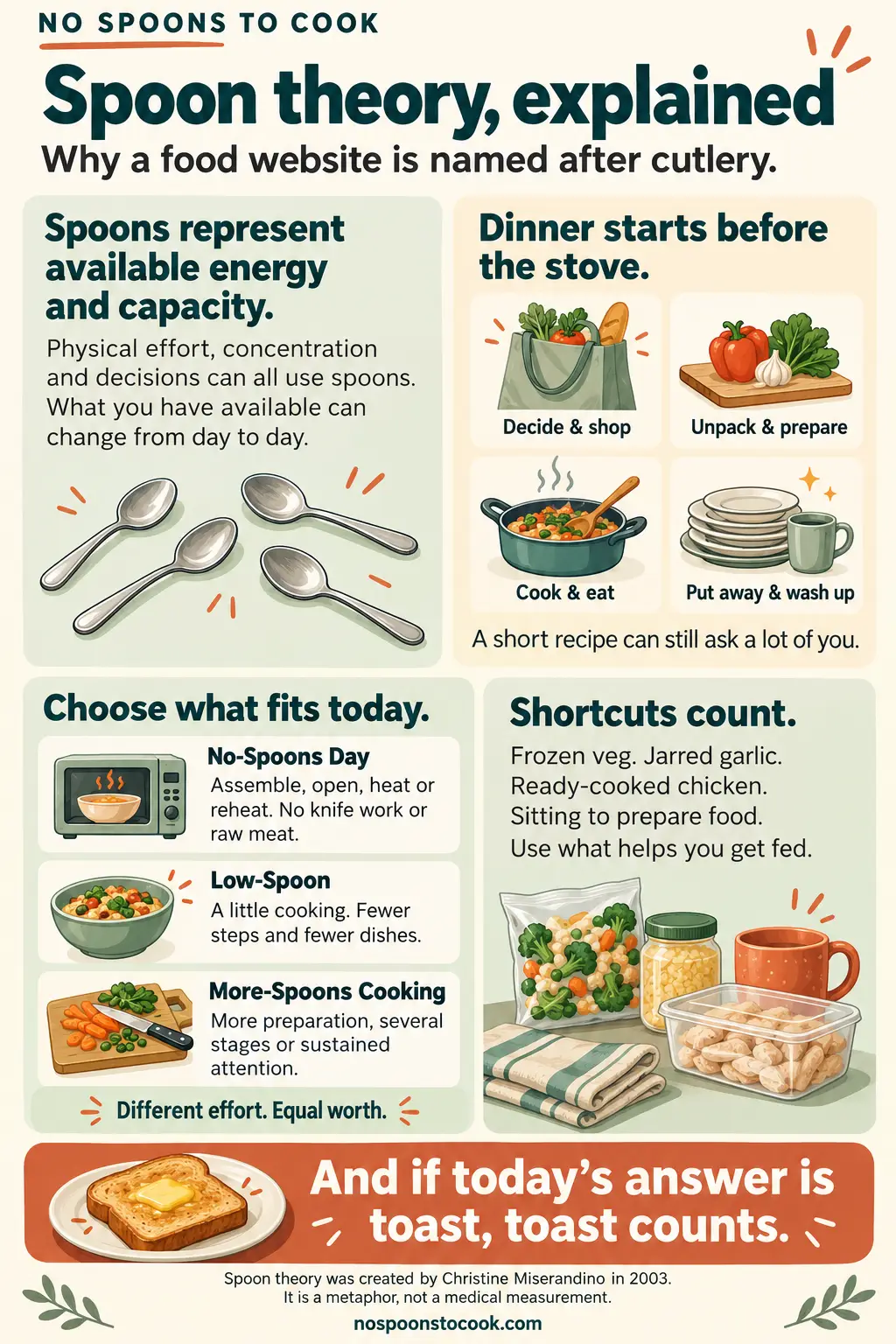
Christine Miserandino came up with it in 2003. A friend asked what living with lupus was really like, and she answered with a handful of spoons. Each spoon was a unit of energy. Every task cost one, and when the spoons ran out, that was the day.
What a spoon actually is
Spoons are shorthand for daily energy: physical, mental and the energy it takes to make decisions. Deciding what’s for dinner costs spoons. So does shopping for it, standing to prepare it and washing up afterwards.
It’s a metaphor, not a clinical model, and I wouldn’t dress it up as one. What it does well is describe something I recognise: a budget that has to cover more than it looks like it can.
Spoon theory in the kitchen
Cooking is often the first thing I drop when energy is low. A recipe that “takes ten minutes” usually hides several separate costs. There’s the standing, the chopping, the decisions and the cleaning up, and none of that shows in the cooking time.
Skipping dinner tends to make the next day harder for me, which is a poor trade. So the question I ask isn’t “what’s the best meal?” It’s “what’s the best meal for the day I’m actually having?”
That’s why recipes on No Spoons to Cook carry a spoon rating: No-Spoons Day, Low-Spoon or More-Spoons. Match the meal to your capacity, not your good intentions. A rating won’t make a flare day easy. It just stops a recipe pretending it will be. Most of the recipes are built around keto and low-carb eating, because that’s how I eat.
If you haven’t read Christine’s original essay, it’s well worth your time. The full post links to it, and explains how the spoon ratings work in practice.
Read the full post on No Spoons to Cook (opens in a new tab)
How many spoons does cooking cost you on a rough day?
More on living with CRPS: my CRPS and advocacy page.